
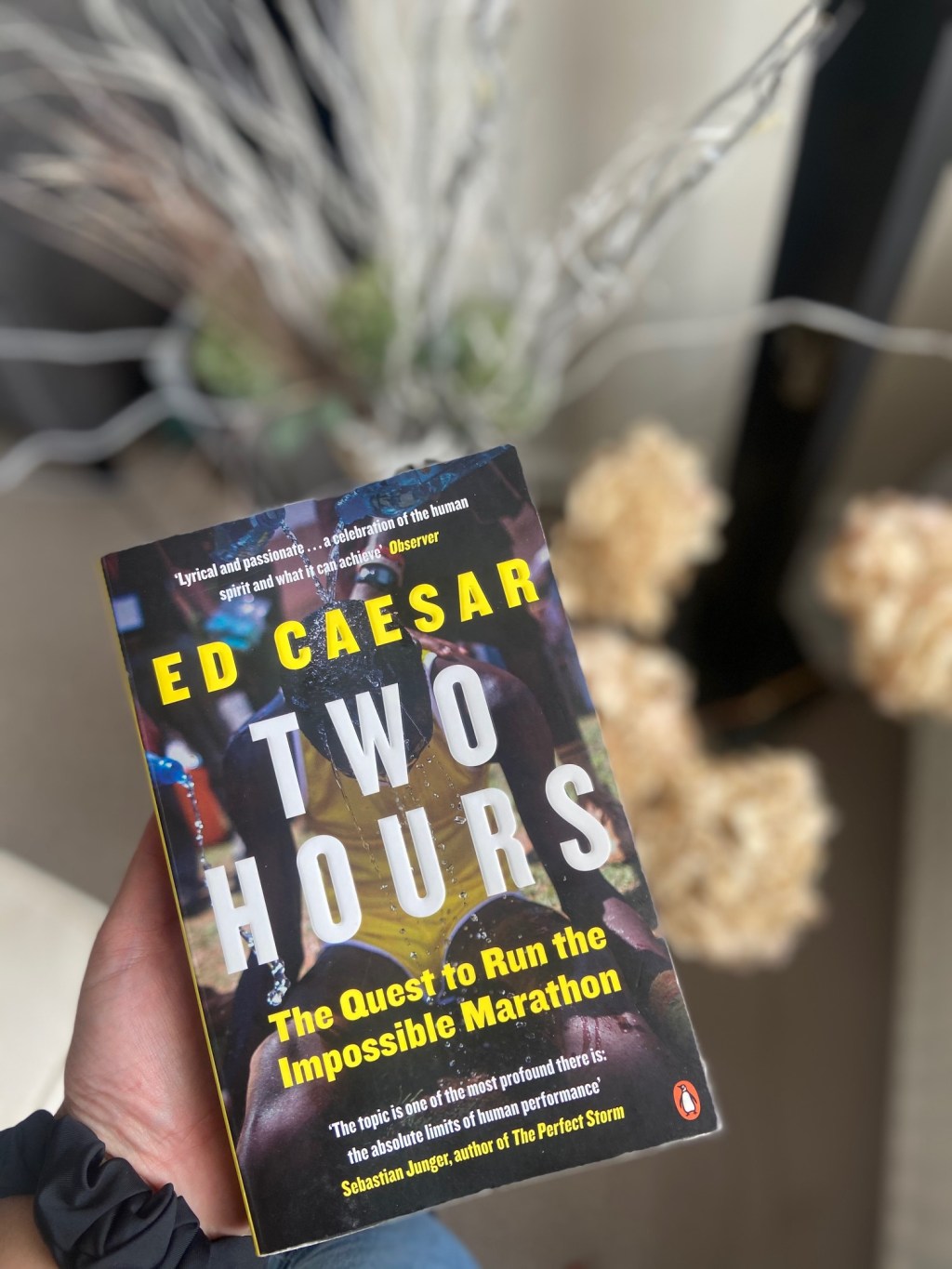
If, like me, you rather enjoy reading about incredible runners and record breaking achievements whilst being the kind of runner who plods around their local Parkrun, then I’ve got a treat for you in the form of this book written by Ed Caesar, Two Hours: The quest to run the impossible marathon.
I’m guessing the title of the book is fairly self explanatory for anyone wondering what it’s about. Journalist and writer Ed Caeser tackles the irresistible topic in road running of the illustrious two hour marathon time and whether any human will physically be able to hit it. The book almost exclusively follows elite Kenyan runner Geoffrey Mutai, who ran the fastest ever marathon time in 2011 in Boston, USA. The book begins there and takes us on a journey from his home in a tiny African village to one of the worlds best marathon runners. It’s not all training technicalities though, as we get glimpses into Geoffrey’s childhood and the environment he grew up in in Kenya, to the life changing amounts of money he started winning when he started getting recognised, to the level of competitiveness amongst the worlds top runners – much of which you and I as everyday runners could not even comprehend.
I admittedly do not follow professional level marathon running particularly closely (although my interest in it grew once I ran my own marathons), but this book is superbly passionate and well-written and I suspect anyone with a passing interest in the elite level of sport would enjoy it. It has such a focus on the boundaries of human performance, along with the determination that these top-level runners have, which really brings you into the story with them. What’s also fascinating, of course, is that the story in the book is anything but fictional.
Ed Caeser also gives us a great history of marathon running and how the big city races as we know them grew in popularity. We learn that marathon running has existed long before the Olympics, and in the 1800’s there were professional running contests around the 25 mile mark. Caesar tells us that for a long time it was ‘considered folly to run so far’. We also learn facts about the big marathon majors we know today and the differences in their course characteristics, including why Boston Marathon doesn’t count for world record purposes.
All in all, I really enjoyed reading this book and despite knowing full well it was real, enjoyed it’s almost fantastical element. The training and paces the pro’s hit is so alien to me personally that to delve into their world felt like some kind of made up world – the beauty of reading in general, I’m sure many of you would agree.
My main criticism of the book is the complete lack of mention of female runners when we talk about ‘the best marathon runners in the world’. I appreciate this book is mostly about Geoffrey Mutai as a male and I don’t want the author to start talking about female runners in an act of tokenism, but there is most certainly an absence which I noticed. One part of the book attempts to explore why African runners, particularly Kenyan’s and Ethiopian’s, dominate professional long distance running so much – and surely this would have been a perfect point to explore how British runner Paula Radcliffe held the women’s marathon record for over a decade, no?
The other thing which readers picking up the book in 2022 might find is that there is a sole passing mention of Kipchoge, and not in the context we know him for today. This is purely because of the time the book was written, pre the Nike and Ineos challenges, but I guess it might feel a little odd for those of us who now know Eliud took the very mark this book is dedicated to.
Overall, if you have an interest in marathon running or any long distance or professional running, this is a great book. Caesar has a brilliant journalistic style of writing whilst really letting you into the world he’s writing about and the people he is shadowing. His access to Mutai is what makes this book personal and his research abilities give real background to the industry, the sport and the human body. It almost feels like we’re reading Mutai’s autobiography. It’s also only about 200 pages long, so you’re not letting yourself into anything too overwhelming.
I think I’ll leave the insanely fast marathon running to someone else for now…and enjoy my 5k plods around the park – but hey, someone’s gotta break those records and I’ll cheer them on when they do 🙂
Have you read this one? I’d love to know what you thought if you read this book and how much you follow professional runners. Comment below!
Love,
Ele x
 chasingele.com